
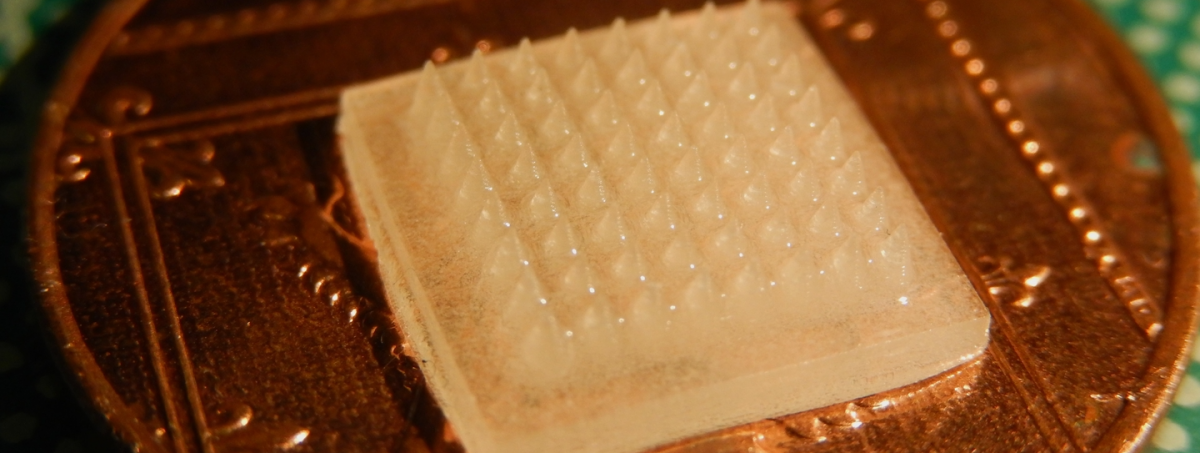
Queen’s University Belfast researchers have developed a dissolvable microneedle patch that could offer a more targeted approach to delivering medicines for localised skin cancer.
Researchers at Queen’s University Belfast have developed a dissolvable 3D-printed microneedle patch designed to deliver two anti-cancer compounds, curcumin and 5-fluorouracil, directly through the skin. The research points to a potential new approach to localised drug delivery that could reduce reliance on repeated topical applications and more invasive administration methods.
Queen’s University Belfast is a major UK research institution with expertise spanning pharmaceutical sciences, advanced manufacturing and biomedical innovation. The work was led by Rutuja N Meshram, a PhD researcher, and Professor Dimitrios A Lamprou, Chair of Biofabrication and Advanced Manufacturing in the University's School of Pharmacy.
The patch uses microscopic dissolving needles that pass through the outer skin layer without drawing blood. The researchers developed a one-step 3D-printing process in which both compounds are incorporated into the printable resin before the microneedles are fabricated, integrating drug formulation with the manufacturing process.
The strategic significance lies in the convergence of pharmaceutical formulation and advanced manufacturing. The study, published in Advanced Healthcare Materials, examines the co-delivery of curcumin and 5-fluorouracil through 3D-printed dissolving microneedles, with the formulation designed to provide controlled biphasic drug release. The research demonstrates how manufacturing parameters can be integrated with drug-delivery design to create more targeted administration systems.
For pharmaceutical developers, this creates a broader opportunity beyond the immediate skin cancer application. 3D printing can allow drug-loaded structures to be designed around specific geometries and release profiles, potentially giving researchers greater control over where and how active ingredients are delivered. Queen’s University Belfast said the approach could ultimately support other medicine-delivery technologies, including vaccines and other therapies.
The patient proposition is equally significant. Because the microneedles dissolve after application, the researchers believe the system could provide a simpler and potentially less painful alternative to some existing delivery methods, while also reducing the risk associated with conventional sharps and medical waste. These remain potential benefits rather than clinically established outcomes, as the research is still at the development stage.
The research also highlights how advanced manufacturing is becoming increasingly relevant to pharmaceutical development itself rather than simply the production of conventional medical devices. The ability to combine active ingredients with a digitally controlled manufacturing process could support future work on personalised dosing, controlled release and patient-specific drug-delivery platforms.
The technology is not yet an approved skin cancer treatment, and further development and clinical evaluation would be required before its use in patients could be established. However, publication of the research provides a peer-reviewed foundation for exploring how 3D printing can be applied to pharmaceutical delivery. RTÉ News reported that the researchers believe the platform could eventually support the delivery of medicines and vaccines in ways that are easier for patients to use.
For the sector, the lesson is direct: pharmaceutical innovation is increasingly extending beyond the molecule itself. By combining drug formulation with advanced manufacturing, researchers can create new delivery platforms designed around precision, controlled release and patient experience, potentially opening another route for the development of next-generation medicines.
Source: RTÉ News / Queen's University Belfast / Advanced Healthcare Materials
















.png)