
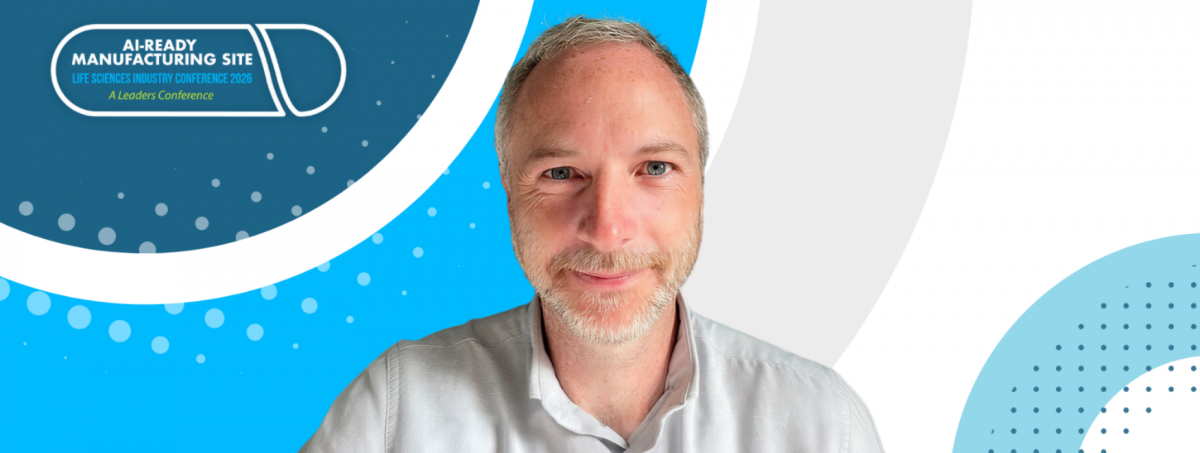
The conversation around AI in life sciences manufacturing is changing. The question is less about whether the technology will arrive and more about whether organisations have built what it takes to scale it responsibly. Ahead of his keynote at the Life Sciences Industry Conference 2026, William Fahey, Data Science Lead at Pfizer, shared what that readiness looks like, and why the cost of waiting is bigger than missing a single tool.
William Fahey leads data science in Pfizer's Manufacturing Intelligence organisation, scaling AI, machine learning and generative AI across its global biopharmaceutical manufacturing network. His keynote, The future of biopharma manufacturing in the age of AI, opens the programme on 22nd October.
For Fahey, 2026 is a tipping point. "I see 2026 as the year AI in life sciences manufacturing starts moving decisively from experimentation to scale," he says. Delay carries a specific risk: "The risk of delaying is not that a company misses one AI tool. It is that it falls behind in building the foundational enablers for AI transformation i.e. data architecture, governance, skills and operating model needed to scale AI responsibly."
Scaling, he argues, comes down to how teams work together. "The most important conversation is about shared accountability and transparency," he explains, warning that "AI will not scale if siloes develop where manufacturing defines the problem, digital builds a model and quality is asked to approve it at the end." The answer is a delivery model that endures: "Scaling accelerates when these conversations become part of a repeatable delivery model, rather than being renegotiated for every use case."
His picture of an AI-ready site is understated. As he puts it, "the first thing I would notice is that there are less people talking about AI!" because, like lean manufacturing and six sigma, "AI would be accepted and embedded in how the site operates." Success would be measured "not by the number of pilots launched, but by whether AI improves outcomes such as process consistency, yield, investigation speed, capacity utilisation and supply reliability."
The question he believes every leader should be asking is direct: "Are we treating AI as another technology project, or are we building the organisational capability to improve how manufacturing decisions are made?" For site leaders still deciding whether to attend the Life Sciences Industry Conference 2026, his advice is practical: "you do not need to arrive with an AI strategy or a complete portfolio of use cases. You need to arrive with the manufacturing problems that matter most to your site."
What he values about events like this is "the openness of the exchange." He also notes the collaborative spirit of the sector: "We compete as organisations, but we share an interest in advancing responsible practices, strengthening supply and ultimately serving patients." That is why he sees real value in candid comparison: "No single organisation has solved every aspect of AI adoption, so there is enormous value in sharing what has worked, what has not and what we have learned."
William Fahey will deliver the keynote at the Life Sciences Industry Conference 2026 this Thursday, 22nd October, at the Crowne Plaza Hotel, Santry. There is still time to secure your delegate place at www.pharmaawards.ie/conference, and you can subscribe to the newsletter to stay informed on speaker announcements and agenda updates.
















.png)